June 2026
When Cardboard Comes to Life
Who Needs Toys When You Have Boxes?
By Kerli Karik-Guilfoyle and Brenda Jordan
Through our weekly visits to the emergency accommodation centres, we have the privilege to provide trauma-informed play sessions for children living there. Our approach is grounded in creating safe, welcoming spaces where children can explore, express, and simply be.
We focus on child-led, sensory-rich activities that prioritise the process over the end product. There are no expectations, no right or wrong ways to create—just opportunities for children to follow their curiosity, build confidence, and connect with others through play.
It’s within this kind of environment that some of the most meaningful moments unfold.
Could you bring some boxes?
When we were leaving after our weekly Stay & Play session in the emergency accommodation centre, we asked the children our usual question: “What would you like to do next week?” The answer came without hesitation:
“
Could you bring some boxes?
— A child, asked what they’d like to do next
So, the following week we arrived armed with boxes of every imaginable shape and size—tall boxes, tiny boxes, long boxes, flat boxes. No instructions, no agenda. Just materials, time, and space. The rest was up to the children.
When cardboard comes to life
As soon as the session began, the creativity flowed. Working alone, in pairs, and in ever-shifting groups, the children painted, decorated, stacked, taped, and engineered with deep concentration. Their ideas were bigger than any toy catalogue could ever offer.
One young artist set to work with purpose, transforming a collection of boxes into a fully realised robot—arms, legs, buttons. He introduced his creation with the unmistakable pride of someone who has brought something entirely new into the world.
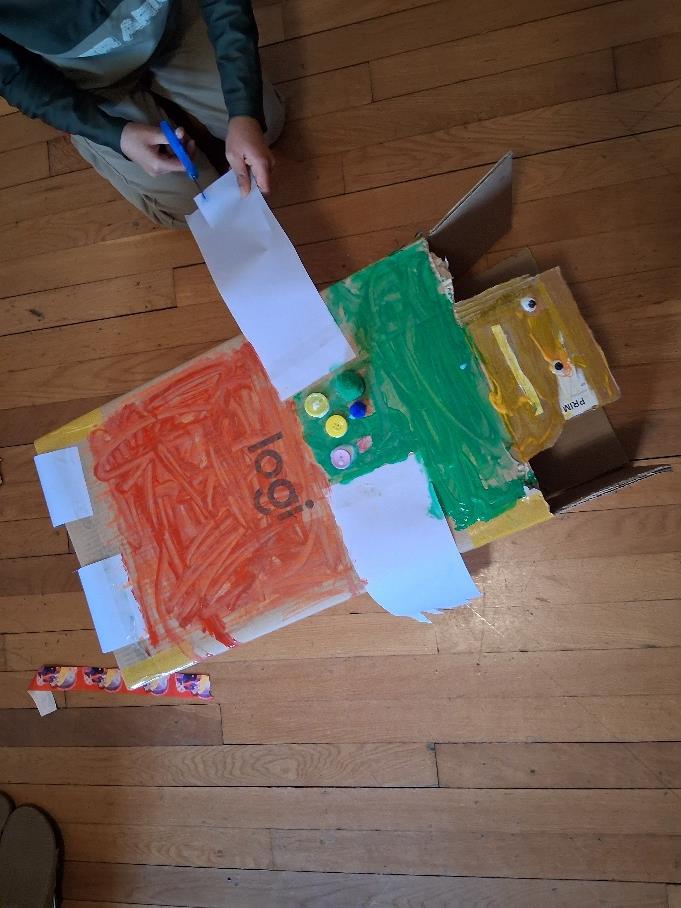 A young artist introduces the robot he built from a collection of boxes—arms, legs and buttons included.
Another child arrived late to find only a small box left. Undeterred, she immediately began crafting a head, complete with hair and facial features.
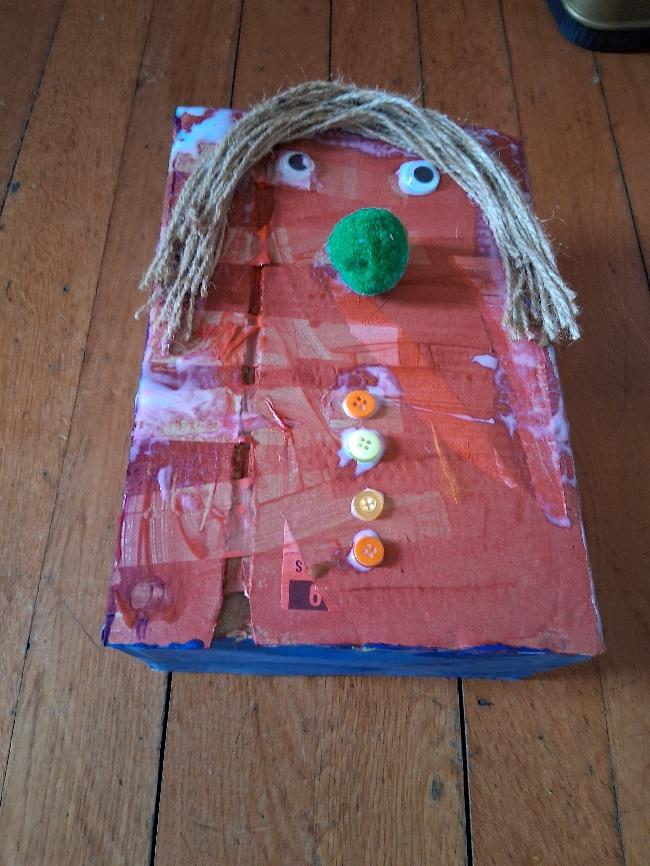 With just one small box, a head took shape—hair, eyes and all.
A moment of collaboration
When she asked the robot’s creator for permission to attach her head to his robot body, a beautiful moment of collaboration unfolded. Together, they taped, adjusted, and refined their shared masterpiece.
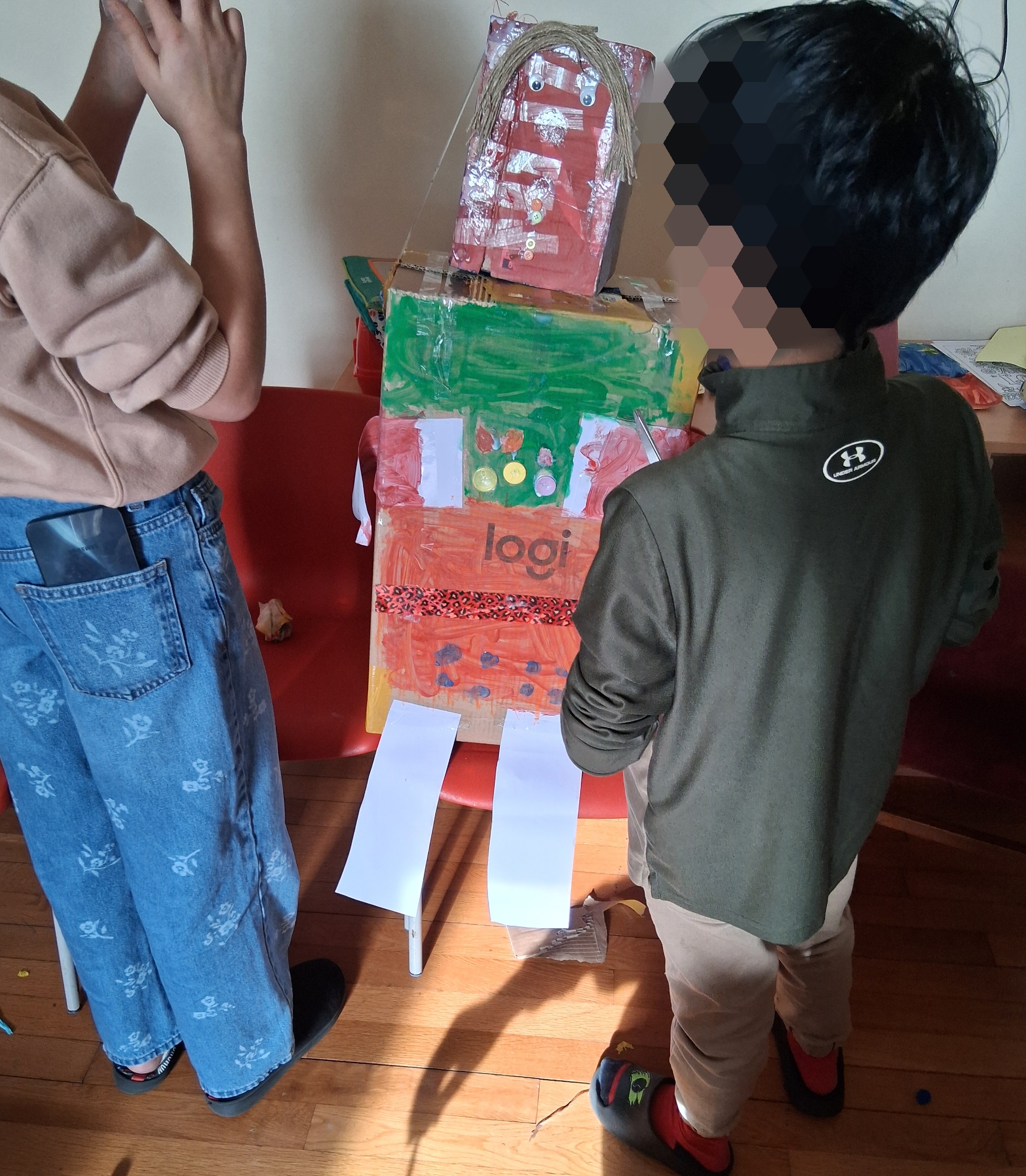 Permission granted—head meets body, and a shared masterpiece begins to take shape.
The loose materials were explored again, and a large sheet of crepe paper was draped around the head. “It’s a hijab,” she announced confidently.
Soon, more children joined the project. The robot evolved into a fully dressed family member, adorned in the finest improvised clothing.
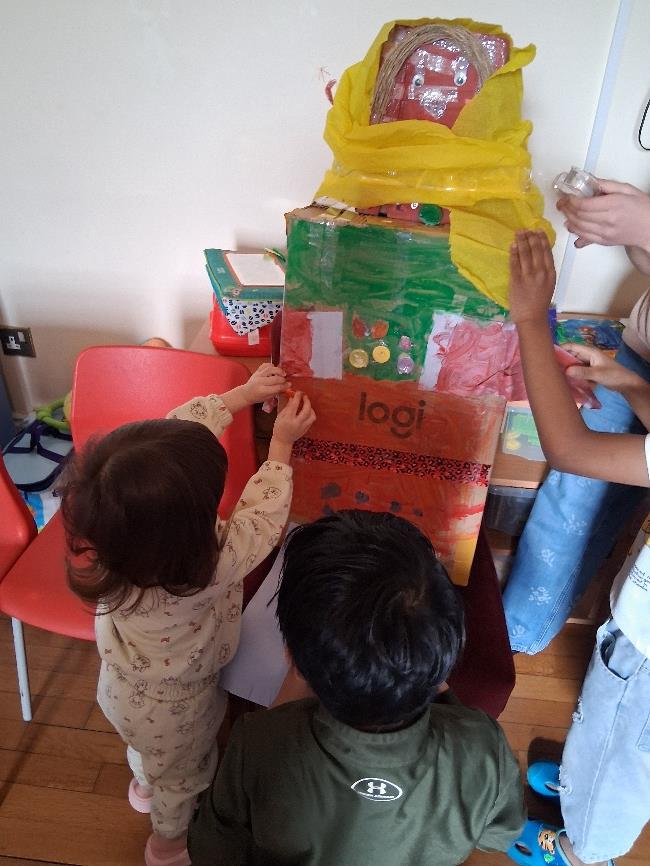 More hands join in—the robot becomes a fully dressed family member in the finest improvised clothing.
The husband and wife
In another corner of the room a second design team were working on their own project. By the end of the hour, the children proudly presented their creations.
“
We made the husband and wife. Next week we will make the babies.
— The children, presenting their creation
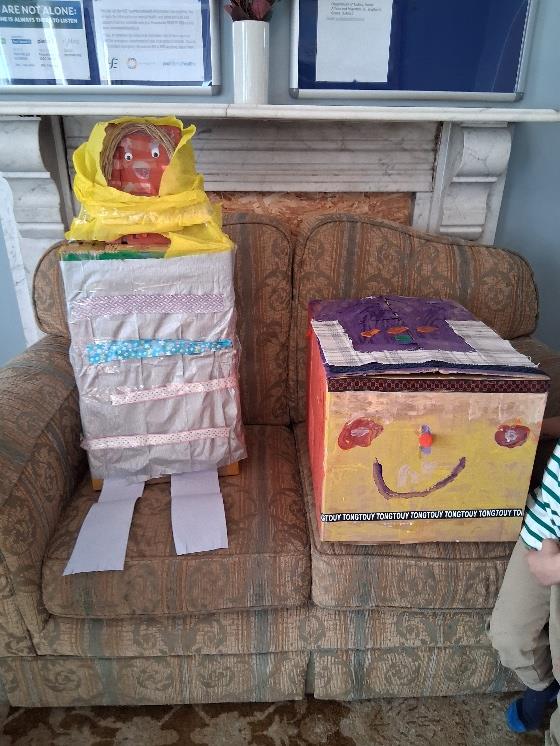 The husband and wife, complete—and a promise to return for the babies.
This session was a powerful reminder of the value of open-ended play. With no set outcomes or expectations, children were free to explore, create, and collaborate in ways that felt meaningful to them. In that space, skills developed naturally, confidence grew, and connections were formed—showing that when we focus on the process, the learning takes care of itself.
What the boxes taught us
- ✨ Loose parts level the playing field. Every child, regardless of age or ability, found a way to participate meaningfully. A small box became just as valuable as a large one.
- ✨ Identity and culture emerge naturally in play. The addition of the hijab showed how children use materials to express what is familiar and meaningful to them.
- ✨ Creativity thrives in community. What began as individual projects grew into a shared endeavour, strengthening relationships, encouraging collaboration, and fostering a strong sense of belonging among the children.
The following week: the family grows
If there was ever any doubt about the value of the activity, the following week reinforced our belief in open-ended, child-led sensory play.
With the sunshine inviting us outside, we brought more boxes—smaller ones this time for the babies—and a variety of craft materials.
It happened to be Eid, and many of the children were out celebrating with their families, but they assured us they would be “back in time.” True to their word, and thanks to a little pester power on their parents, they all returned promptly, buzzing with excitement and urgency.
The “husband and wife” from the previous week made their return and were dressed in new outfits from the craft materials for the occasion. They eagerly set about creating the baby they had promised. When the little one “cried a lot,” the children quickly noticed the parents’ distress and jumped into problem-solving. Spotting a sticker of a soother, they placed it on the baby’s mouth, calming the infant and completing the family.
The hour and a half passed in what felt like moments. Both children and adults left the session reluctant to say goodbye, reminded once again of the joy, creativity, and connection that open-ended play brings.
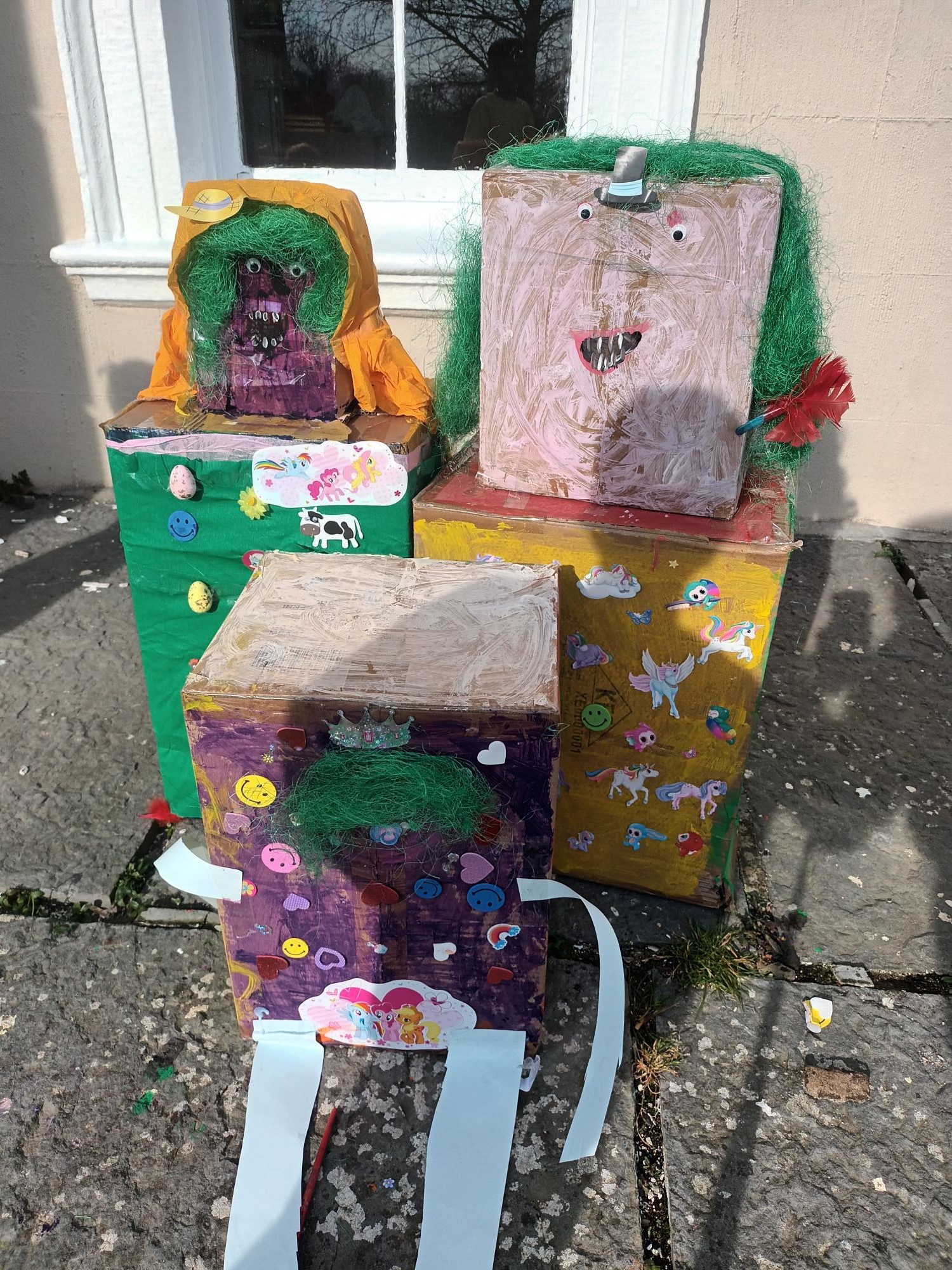 The finished cardboard family, out in the sunshine—mam, dad and baby all together.
Proud of their work, the children insisted that the mam, dad, and baby come back to the office with us—a place where, to this day, they have pride of place.
With no set outcomes and nothing but boxes, time and space, the children explored, created and connected in ways that felt meaningful to them. When we focus on the process, the learning takes care of itself.